
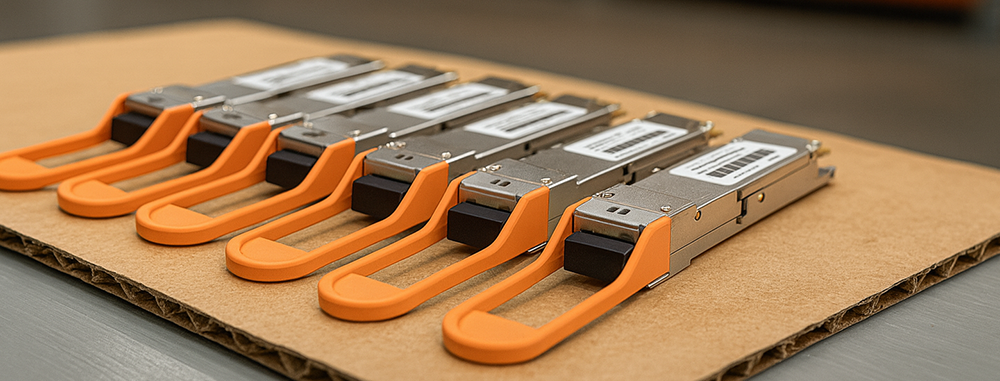
Looking Beyond Performance: The Cost Factor in 100G Optics
When planning a 100G network, performance is usually the first thing people think about—bandwidth, reach, latency, all the obvious metrics. But once you get into actual deployment discussions, cost quickly becomes just as important, sometimes even more so.
This is exactly where 100GBASE-ZR4 starts to stand out.
Under the IEEE 802.3 definition, ZR4 modules support 100Gbps transmission over single-mode fiber up to 80 kilometers. That already puts them in a category that overlaps with some transport-layer technologies. But what makes them interesting isn’t just what they can do—it’s how they simplify what would otherwise be a more expensive solution.
Instead of building a full optical transport system, ZR4 allows you to achieve long-distance connectivity using pluggable modules alone.
And that has a direct impact on overall network cost.
Reducing Infrastructure Complexity
In traditional long-distance optical designs, especially beyond 40km, you often need additional equipment—transponders, amplifiers, and sometimes full DWDM systems.
These components add not only to the upfront cost but also to operational complexity.
With 100GBASE-ZR4, much of that complexity is removed.
The module itself handles the optical transmission, meaning you can connect two sites directly without introducing extra layers into the network. In some cases, that eliminates entire categories of hardware.
From a budgeting perspective, this matters.
Less equipment means lower capital expenditure, but it also reduces space, power consumption at the system level, and ongoing maintenance requirements.
Even if the module itself is not cheap, the overall system cost can still come out lower.
Optimizing Existing Fiber Assets
Another angle where ZR4 shows its value is in how it uses existing fiber infrastructure.
Many organizations already have single-mode fiber deployed between locations, sometimes installed years ago. Upgrading these links to higher bandwidth doesn’t always require new fiber—it just requires better use of what’s already there.
ZR4 modules operate over standard duplex single-mode fiber, without needing specialized configurations.
That makes them a good fit for networks that want to scale capacity without investing in new physical infrastructure.
Instead of digging trenches or deploying additional cables, you upgrade the optics and keep everything else the same.
This kind of optimization is often overlooked, but it can significantly reduce project costs.
Balancing Cost and Scalability
Of course, cost efficiency doesn’t mean sacrificing scalability—but it does mean making trade-offs.
ZR4 is designed for point-to-point links. It doesn’t offer the same level of flexibility as wavelength-tunable or coherent solutions. If you need to scale beyond a certain point, or support more complex topologies, you may eventually need to move to a different technology.
But not every network needs that level of flexibility right away.
For many deployments, especially those with predictable traffic patterns, a fixed 100G link is more than enough.
In these cases, ZR4 provides a cost-effective way to meet current demand without over-investing in future capacity that may not be needed yet.
It’s about matching the solution to the actual requirement, not the theoretical maximum.
Real-World Cost Scenarios
Consider a regional enterprise with two data centers located 60–70 kilometers apart.
One option is to deploy a full optical transport system, with all the associated equipment and configuration. That provides maximum flexibility, but also comes with higher costs and longer deployment time.
Another option is to use 100GBASE-ZR4 modules.
With ZR4, you can establish a direct connection between switches at each site. No additional transport layer, no complex setup. Just a straightforward 100G link.
In many cases, that’s enough.
The savings come not only from reduced equipment but also from faster deployment and simpler operations.
Over time, those operational savings can add up just as much as the initial cost reduction.
Operational Efficiency Over the Long Term
Cost isn’t just about what you spend at the beginning. It’s also about what you spend over time.
ZR4 modules tend to be easier to manage compared to more complex optical systems. There’s less configuration, fewer components to monitor, and fewer points of failure.
That translates into lower operational overhead.
Network teams can spend less time troubleshooting and more time focusing on higher-level tasks. Training requirements are also lower, since the technology behaves more like standard Ethernet optics than specialized transport equipment.
All of this contributes to the total cost of ownership.
Even if the differences seem small at first, they become more significant over the lifespan of the network.
When ZR4 Might Not Be the Best Choice
It’s worth being clear—ZR4 isn’t always the most cost-effective option.
If your network requires very high scalability, flexible wavelength management, or extremely long distances beyond 80km, then coherent optics or DWDM systems may provide better value in the long run.
Similarly, if you’re building a new network from scratch with long-term growth in mind, investing in a more flexible solution upfront could make more sense.
ZR4 works best when you already have infrastructure in place and need to extend its capabilities without major changes.
It’s a solution for specific scenarios, not a universal answer.
Conclusion
100GBASE-ZR4 offers a unique approach to long-distance networking by focusing not just on performance, but on cost efficiency and simplicity. By enabling 100G transmission over existing single-mode fiber without the need for complex transport systems, it helps reduce both capital and operational expenses. While it may not provide the same level of flexibility as more advanced optical technologies, it delivers exactly what many networks need: reliable, high-capacity connectivity with minimal complexity. For organizations looking to balance performance with cost, ZR4 remains a practical and effective choice.
